
Historically, airports have relied heavily on aeronautical revenue — landing fees, passenger service charges, and airline rents. However, larger airports facing increasing pressure on margins and fluctuating flight volumes have increasingly turned to non-aeronautical revenue as a cornerstone of financial sustainability.
From retail and concessions to real estate and advertising, major commercial hub airports are diversifying income streams like never before. While the scale and feasibility of these opportunities vary significantly by airport size, this diversification can stabilize income and improve the traveler experience — creating a win-win for both airport operators and passengers where traffic volumes support such investments.
Yet, capturing and managing these revenue opportunities is far from simple. That’s where TADERA’s Airport Business & Revenue Manager (ABRM) steps in.
Understanding Airport Revenue Models
Airport income typically falls into two categories:
- Aeronautical Revenue: Income from airlines (landing fees, parking, passenger charges).
- Non-Aeronautical Revenue: Income from businesses operating within airport premises — such as shops, restaurants, rental car agencies, parking, advertising, and land leases.
While aeronautical revenue is directly tied to aircraft operations and passenger throughput with rates often regulated, non-aeronautical revenue – though also affected by traffic levels – can offer airports greater flexibility through diversified sources like parking, retail, and property leasing, providing additional resilience during downturns in air trave
Forward-thinking airport authorities are investing in digital tools to manage this revenue efficiently, ensuring that every square meter of airport property contributes to profitability.
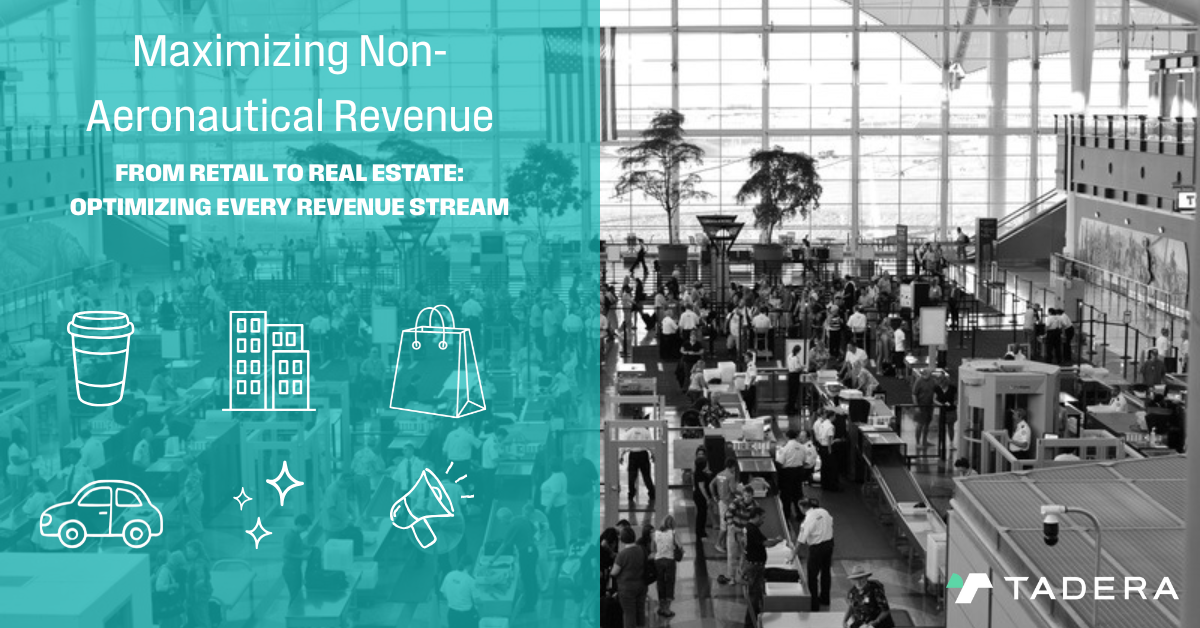
Breakdown of Non-Aeronautical Revenue Sources
To understand where airports can grow, let’s explore key non-aeronautical revenue streams:
|
Revenue Source |
Description |
|
Retail and Duty-Free |
Sales commissions and rent from retail stores and duty-free outlets. |
|
Food and Beverage |
Revenue from restaurants, cafes, and bars across terminals. |
|
Advertising & Sponsorships |
Digital and physical ad placements throughout terminals and access roads. |
|
Parking & Ground Transport |
Income from passenger parking and partnerships with ride-share operators. |
|
Real Estate and Leasing |
Long-term leases for hotels, offices, cargo terminals, and hangars. |
|
Other Services |
Wi-Fi access, lounges, VIP services, and car rental facilities. |
These revenue streams demand transparent lease management, accurate billing, and automated finance tracking to ensure airports don’t leave money on the table.
Why Lease and Billing Tools Are Critical
Many airports still manage leases and billing through disconnected systems or spreadsheets — a process prone to errors, delays, and revenue leakage. Without an integrated system, airports struggle to:
- Track lease expirations and renewals
- Reconcile rent payments and usage-based charges
- Generate timely invoices and audits
- Monitor concession performance
Modern airports require airport lease management software and airport property billing automation that can handle complex contracts, dynamic pricing models, and financial reporting in real time.
This is where airport finance software like ABRM provides a competitive edge.
How ABRM Helps Optimize Non-Aeronautical Revenue
TADERA's Airport Business & Revenue Manager (ABRM) is a comprehensive platform purpose-built to help airports unlock, manage, and strategically grow their non-aeronautical revenue streams with precision and confidence.
1. Centralized Agreement Management Across All Revenue Streams
Manage every revenue-generating agreement in one unified system—from terminal retail and concessions to FBO leases, rental car contracts, cargo facilities, advertising, parking operations, and ground transportation permits. ABRM tracks critical details including lease terms, renewal dates, rent escalations, Minimum Annual Guarantees (MAGs), percentage rent calculations, and capital improvement requirements—ensuring nothing falls through the cracks and every revenue opportunity is captured.
2. Automated Billing & Revenue Recognition
Generate accurate, audit-ready invoices automatically based on complex contract terms and actual performance data. Whether calculating percentage of gross receipts, applying CPI adjustments, reconciling MAGs against actual sales, or billing landing fees and terminal rent, ABRM eliminates manual spreadsheet calculations and reduces revenue leakage while improving billing accuracy and transparency.
3. Strategic Revenue Intelligence
ABRM transforms raw data into actionable insights through comprehensive revenue dashboards and analytics. Airport finance directors gain visibility into performance by tenant, location, and revenue category—identifying underperforming assets, tracking compliance with sales reporting requirements, benchmarking rates against comparable facilities, and uncovering opportunities to optimize lease terms during renewals. This empowers leadership to make strategic, data-driven decisions that directly impact the bottom line.
4. Built-In Compliance and Audit Readiness
ABRM maintains complete digital documentation of every transaction, contract amendment, payment, and tenant communication. The system helps airports collect the data needed for GASB 87/96 lease accounting reports, creates comprehensive rent rolls, tracks receivables aging, and provides audit trails. Taken together, these features can dramatically reduce the time and stress associated with annual audits and regulatory compliance reviews.
5. Enterprise Integration and Scalability
ABRM integrates seamlessly with airport ERP systems, accounting platforms, and operational management tools, creating a single source of truth for non-aeronautical revenue. As your airport grows, ABRM supports increasing complexity without requiring additional administrative resources.
Tangible Benefits for Airport Executives
Airports using ABRM have reported:
- Improvement in non-aeronautical revenue tracking accuracy
- Significant reduction in billing and reconciliation time
- Better decision-making through financial visibility
- Enhanced tenant relationships and compliance confidence
In essence, TADERA ABRM turns complexity into clarity, helping airports operate more profitably and efficiently.
Future-Ready Revenue Management
As airports evolve into multi-modal commercial hubs, the role of digital revenue management systems becomes more crucial. Software that can adapt to emerging business models — like e-commerce, dynamic retail, and smart property analytics — will define tomorrow’s airport leaders.
With TADERA ABRM, airports can confidently move toward that future — where every square foot generates value, every transaction is transparent, and every decision is backed by data.
Ready to optimize your airport's financial performance?
Discover how TADERA ABRM can help your airport maximize non-aeronautical revenue and simplify financial management.
Schedule a Demo or explore more at tadera.com.
Aabha Upadhyaya
Aabha Upadhyaya is a Marketing and Communication Specialist at TADERA with three years of experience in transportation SaaS and technology. She supports branding, digital campaigns, and content focused on aviation challenges, airport management, and airport security solutions.