Airport expansion projects don’t fail during construction.
They fail after.
When new terminals, systems, and vendors are introduced, operations become:
- Fragmented
- Inconsistent
- Difficult to manage
The issue is not infrastructure. It is airport operations integration.
And most airports underestimate how complex that becomes until it starts breaking.
Why Integration Fails in Airport Projects
Integration is usually treated as a technical task.
It’s not.
It’s an operational alignment problem.
Systems Are Selected in Isolation
During expansion:
- Different teams choose different systems
- Vendors are selected independently
- Requirements are not aligned
Result: Systems don’t talk to each other.
Integration Is Deferred Until Late Stages
Integration is often addressed:
- After systems are implemented
- Under time pressure
- Without full visibility
By then, fixing it is expensive and complex.
Vendors Overpromise, Deliver Partial Integration
“API-ready” does not mean:
- Fully integrated
- Real-time synced
- Operationally aligned
You end up with:
- Partial connections
- Manual data fixes
- Ongoing maintenance issues
No Clear Ownership of Integration
Who owns integration?
- IT?
- Operations?
- Vendors?
When ownership is unclear, integration gaps remain unresolved.
Operational Disruption Risks
When systems don’t integrate, operations degrade quickly.
1. Inconsistent Workflows Across Terminals
Different systems lead to:
- Different processes
- Conflicting procedures
- Training complexity
2. Delayed Decision-Making
Data is:
- Scattered
- Delayed
- Inconsistent
Leaders don’t get a real-time operational view.
3. Increased Manual Workarounds
Teams compensate by:
- Exporting data
- Using spreadsheets
- Re-entering information
This introduces errors and slows operations.
4. Higher Risk During Peak Operations
During high traffic:
- Small inefficiencies scale quickly
- System delays compound
- Coordination breaks down
This directly impacts performance.
Data Silos and System Fragmentation
This is the core problem.
Expansion introduces more systems, not better systems.
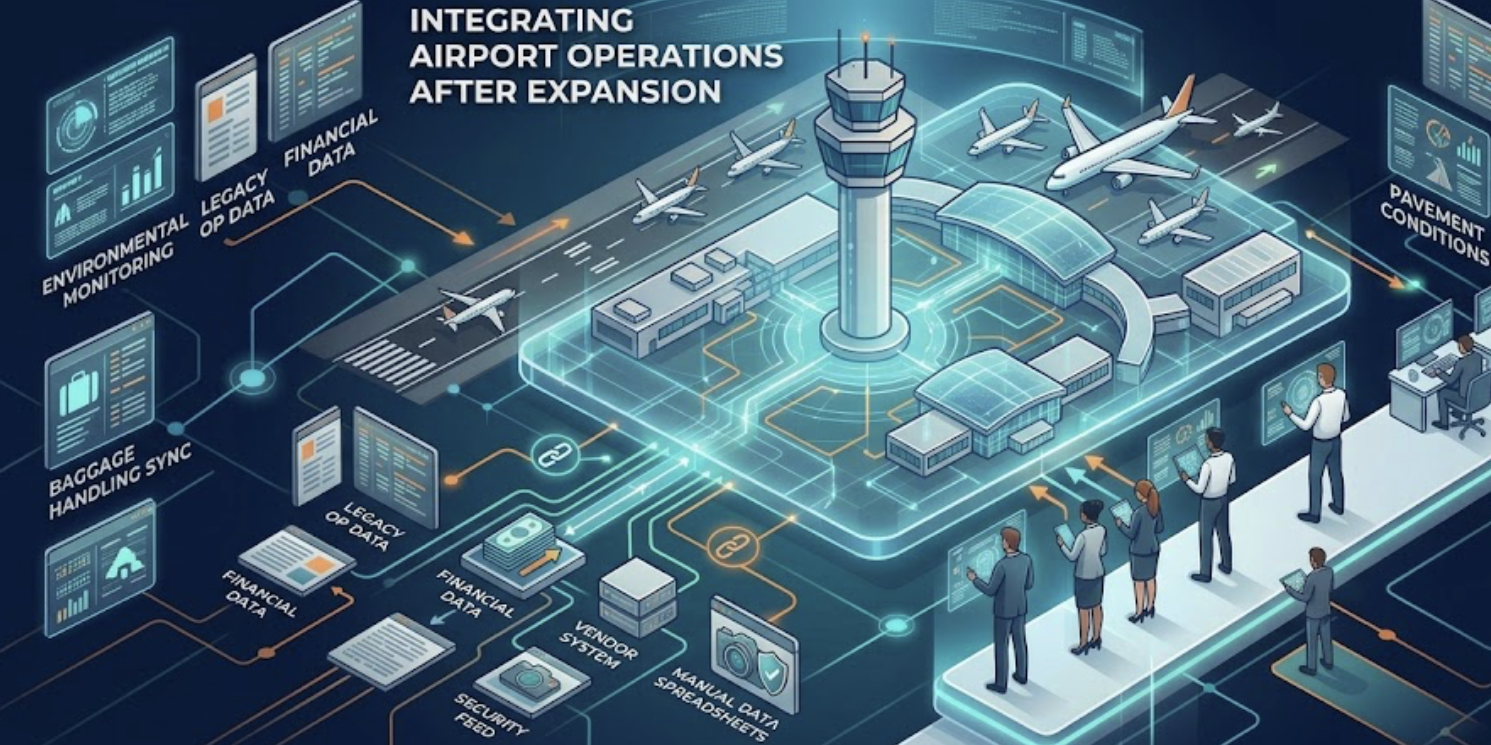
Disconnected Data Sources
- Operations data in one system
- Financial data in another
- Security data elsewhere
No unified view exists.
Duplicate and Conflicting Data
- Same data entered multiple times
- Different versions across systems
- No clear source of truth
Limited Interoperability
Legacy and new systems often:
- Use different standards
- Don’t sync in real time
- Require custom integrations
Long-Term Maintenance Burden
Every integration becomes:
- A dependency
- A cost
- A risk point
Over time, complexity increases instead of decreasing.
Integration Framework for Airports
Fixing integration is not about connecting systems randomly. It requires structure.
1. Define Operational Workflows First
Before integration:
- Map how operations should function
- Identify cross-department dependencies
- Define data flow requirements
Technology should support workflows, not define them.
2. Establish a Unified Data Model
- Define core data entities
- Standardize data formats
- Ensure consistency across systems
Without this, integration becomes patchwork.
3. Prioritize High-Impact Integrations
Focus on:
These areas drive the most value.
4. Reduce System Redundancy
- Eliminate duplicate systems
- Consolidate where possible
- Avoid overlapping functionality
More systems ≠ better operations.
5. Implement Integration Governance
- Define ownership
- Set integration standards
- Monitor system performance
Integration is not a one-time project. It is ongoing.
Long-Term Scalability Considerations
Most airports fix integration for today and recreate the problem later.
Can the System Scale with Growth?
- New terminals
- Increased traffic
- Additional services
If scaling requires re-integration, the system is flawed.
Does It Support Interoperability Standards?
- Open APIs
- Standardized data exchange
- Vendor flexibility
Closed systems create long-term constraints.
Industry guidance from Airports Council International (ACI) emphasizes interoperable airport IT systems and standardized integration practices to support long-term operational efficiency.
Is There a Clear Integration Roadmap?
- Future system additions
- Planned upgrades
- Data strategy
Without a roadmap, complexity returns.
Where TADERA Fits In
Most airports don’t lack systems. They lack structure in how those systems work together.
- Define integration frameworks aligned with operations
- Identify system overlaps and gaps
- Evaluate interoperability across vendors
- Create scalable integration roadmaps
Instead of reacting to post-expansion chaos, you build a controlled, connected operations environment.
Final Thoughts: Expansion Without Integration Creates Operational Chaos
Expansion increases capability.
But without integration, it also increases:
- Complexity
- Risk
- Inefficiency
Most airports invest heavily in infrastructure and underestimate the cost of disconnected systems.
That’s the mistake.
Because in the end, operations don’t fail due to lack of systems.
They fail because those systems don’t work together.
If your airport is struggling with post-expansion system fragmentation, start by identifying where integration is breaking down.
Aabha Upadhyaya
Aabha Upadhyaya is a Marketing and Communication Specialist at TADERA with three years of experience in transportation SaaS and technology. She supports branding, digital campaigns, and content focused on aviation challenges, airport management, and airport security solutions.