Airports make capital decisions years before infrastructure is built. A terminal expansion, runway improvement, utility upgrade, or facility replacement may require long lead times for planning, design, funding, environmental review, procurement, and construction.
That makes capital forecasting less about predicting one exact future and more about building a defensible view of future needs under different assumptions.
A useful airport capital forecast connects infrastructure demand, asset condition, capacity, project timing, funding, and financial constraints so leaders can determine which investments may be required, when they may be needed, and how they fit into the broader capital program.
Why airport capital forecasting matters
Poor forecasting can create two opposite problems. An airport can defer an investment until a capacity or asset condition issue becomes urgent, or it can prioritize projects before the need, funding, or timing is sufficiently understood.
Forecasting helps create a planning horizon. It gives airport leadership a structured way to compare future needs and connect them to the capital program.
The data needed for a credible capital forecast
-
Passenger and activity trends.
-
Existing facility capacity and utilization.
-
Asset condition and remaining useful life.
-
Planned maintenance and replacement cycles.
-
Master planning assumptions.
-
Existing capital projects and commitments.
-
Funding availability and restrictions.
-
Historical project costs and schedule performance.
-
Regulatory, safety, or operational requirements.
Separate demand forecasting from capital prioritization
Forecasting demand is not the same as deciding which capital project should be funded. A forecast may indicate that capacity pressure is increasing, while the capital plan still needs to compare alternatives, timing, cost, funding, and operational impact.
Keeping these steps distinct makes the decision process easier to explain and defend.
Build scenarios instead of relying on one forecast
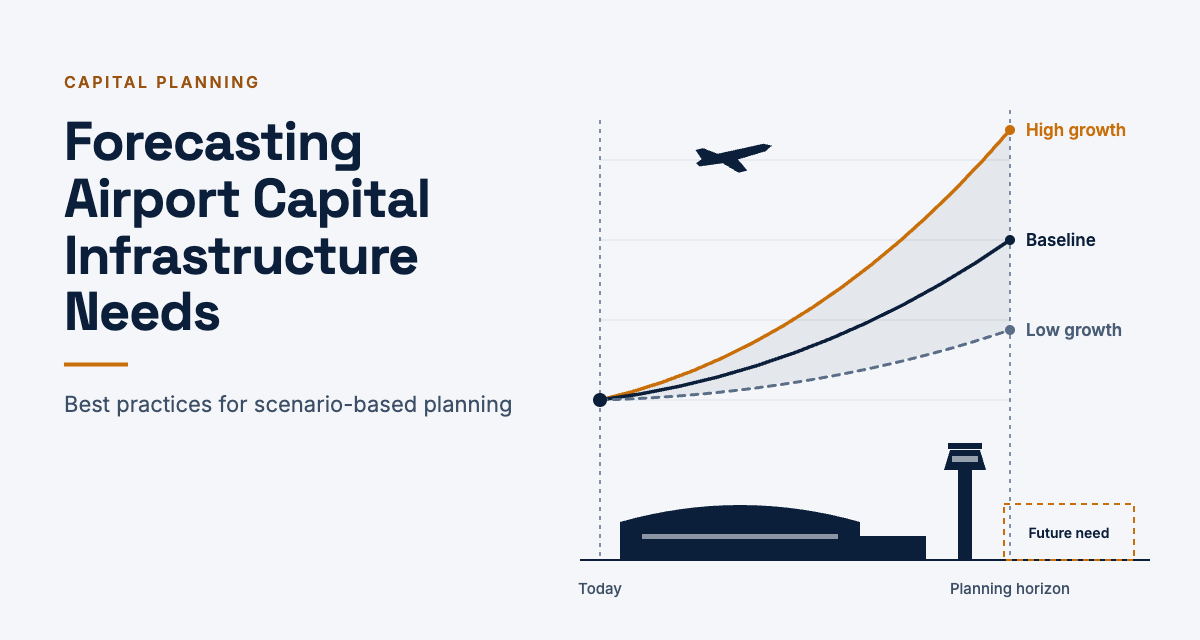
Airport activity can change because of airline schedules, passenger demand, economic conditions, major events, facility constraints, or other external factors. A useful planning model can therefore examine multiple scenarios rather than treating one projection as certain.
For example, airport leaders might compare a baseline scenario with higher- and lower-growth assumptions and then identify which infrastructure investments remain necessary across scenarios.
Connect forecasts to the capital program
A forecast becomes operationally useful when it influences project timing and prioritization. The process can move from forecast inputs to identified needs, candidate projects, estimated costs, funding strategies, schedules, and program-level priorities.
This is where project and financial systems become important. Forecasts should be compared with actual project costs, commitments, schedules, and funding so that future planning can learn from current program performance.
Where TADERA can support capital planning
TADERA's Airport Capital Program Manager provides tools for managing capital projects, budgets, funding, schedules, expenses, and reporting. That creates a system of record for the capital program that can support the planning process around future infrastructure needs.
TADERA's ABRM should be positioned separately when the forecasting discussion concerns airport commercial and revenue data. ABRM centralizes airport financial and property information, including billing, agreements, revenue reporting, and other data that can support financial planning. It should not be described as a standalone predictive infrastructure-forecasting engine.
A practical airport capital forecasting framework
-
Establish the planning horizon.
-
Define the infrastructure categories being forecast.
-
Collect and validate demand, capacity, asset, and financial inputs.
-
Document assumptions and data sources.
-
Build baseline and alternative scenarios.
-
Translate forecast needs into candidate capital projects.
-
Estimate cost, timing, funding, and operational impact.
-
Prioritize projects using transparent criteria.
-
Compare the forecast with actual project performance.
-
Refresh assumptions as new information becomes available.
Questions to ask when evaluating forecasting technology
-
What data does the model use?
-
Can assumptions be documented and changed?
-
Can scenarios be compared?
-
Can forecasts be connected to capital projects and budgets?
-
Can actual performance be compared with planned assumptions?
-
Can the resulting analysis be explained to finance, engineering, leadership, and stakeholders?
Conclusion
Airport capital forecasting is most valuable when it becomes part of an ongoing capital-management process. The goal is not to claim certainty about future infrastructure needs. It is to create a transparent, data-supported planning framework that can be updated as demand, asset conditions, project costs, and funding change.
Talk to TADERA
Connect infrastructure planning with the project, budget, funding, and reporting information needed to manage an airport capital program. Explore TADERA Airport Capital Program Manager.
Aabha Upadhyaya
Aabha Upadhyaya is a Marketing and Communication Specialist at TADERA with three years of experience in transportation SaaS and technology. She supports branding, digital campaigns, and content focused on aviation challenges, airport management, and airport security solutions.